
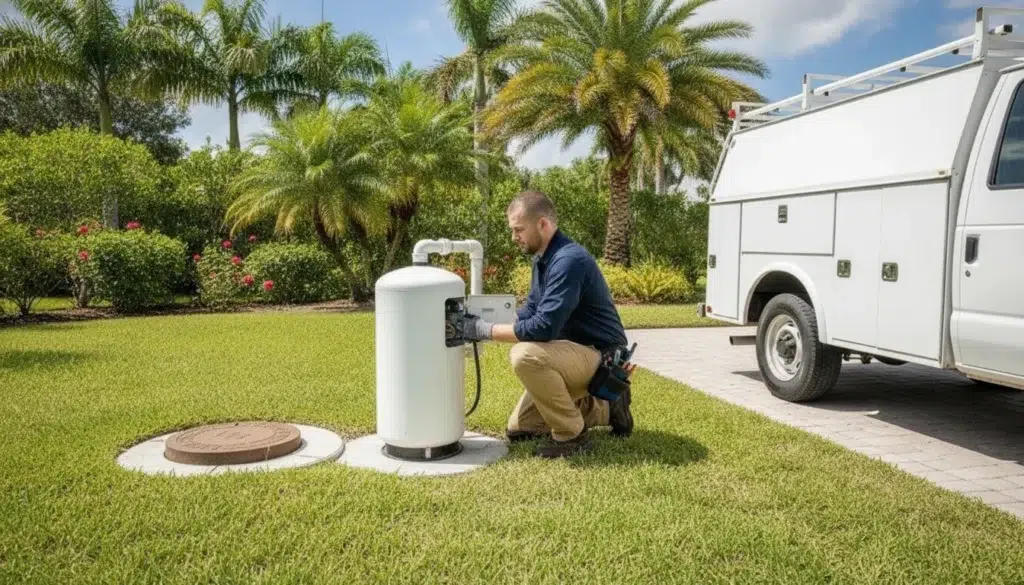
A private well pump is the equipment that draws water from your well and delivers it to your home’s plumbing system. When the pump, pressure tank, controls, or wiring develops a problem, the first clue may be weak water pressure, sputtering faucets, or no water at all.
Searching for “well pump repair fort myers fl” usually points to a home where water pressure has dropped. The pump is cycling on and off too often, faucets sputter, or the system has stopped supplying water entirely. We inspect the full well system, identify whether the issue is mechanical or electrical, and explain whether a repair or replacement is the more dependable option.
At Whiskey Creek Plumbing, we help Fort Myers and Lee County homeowners troubleshoot these failures with clear recommendations, fixed-price service, and 24/7 emergency support when needed. You can also explore our plumbing services for related plumbing concerns. Start by learning which warning signs deserve prompt attention.
Call Whiskey Creek Plumbing at (239) 785-9022
Signs Your Well Pump Is Failing
A well pump usually gives you clues before it stops working completely. In a Fort Myers home, pay attention to changes in pressure, water appearance, electrical use, and how often the pump turns on and off. These symptoms can point to a failing pump, a pressure-tank problem, a clogged component, or another issue in the well system. A professional diagnosis helps identify the actual cause before a small repair becomes a larger interruption.
No water pressure or weak flow
A sudden loss of water pressure is one of the clearest warning signs. You may notice that showers lose force, faucets barely run, or multiple fixtures cannot operate at the same time. No pressure can result from a failed pump, an electrical problem, a damaged pressure switch, or a drop in the well’s water level. If pressure gradually declines, the system may also have a clogged filter or a failing tank.
Sputtering faucets and air in the lines
Faucets that spit, sputter, or release bursts of air can indicate that the pump is not delivering water consistently. The system may be struggling to maintain prime, drawing down the well, or operating with a damaged component. Do not assume the faucet itself is the problem if several fixtures behave this way. Note when the sputtering occurs and whether it happens after heavy household water use.
Cloudy, dirty, or discolored well water
Cloudy or discolored water deserves prompt attention, especially when the change affects every fixture. Sediment can enter the system when a pump is disturbed, a well component fails, or the water level changes. However, appearance alone cannot confirm whether water is safe to drink. Private-well owners are responsible for monitoring their water quality, and the EPA recommends regular testing for items such as total coliform bacteria, nitrates, total dissolved solids, and pH. Test again after a well-system repair.
Higher electric bills or rapid pump cycling
An unexpectedly high electric bill can occur when a pump runs longer or more often than normal. Listen for a motor that starts repeatedly, even when no fixture is open. This pressure-tank short-cycling can wear out the pump motor and may result from a waterlogged tank, incorrect pressure settings, a leak, or a failing switch. Frequent cycling should be checked rather than ignored.
For a closer look at symptoms, review these well pump repair warning signs. If you need help beyond the pump itself, our plumbing services cover related water and plumbing system issues.
Well Pump Repair vs. Replacement: How to Decide
The right choice depends on the pump’s age, the cause of the failure, and how often the system has needed service. A single failed component does not always mean the entire pump is finished. However, continuing to repair an aging system can cost more than installing a dependable replacement, especially when a breakdown leaves your Fort Myers home without reliable water.
As a practical rule, a pump that is more than 10 years old, or one that needs frequent repairs, is often more cost-effective to replace. A technician should still test the electrical supply, pressure switch, pressure tank, wiring, and pump before making that recommendation. That diagnosis helps separate a pump failure from a problem elsewhere in the well system.
| Decision factor | Repair | Replacement |
|---|---|---|
| Expected lifespan | Preserves the remaining life of the existing pump. It makes the most sense when the pump is relatively young and the failed part is isolated. | Provides a new service life and may be the better fit when the existing pump is over 10 years old or has reached the end of its dependable operation. |
| Upfront cost | Usually requires less money at the start when the issue is a switch, wiring connection, or other replaceable component. | Requires a larger initial investment because the pump and, when needed, related equipment must be removed and installed. |
| Long-term cost | Can become more expensive if the same pump continues to fail or requires repeated service calls. | May reduce repeat repair costs and improve reliability, particularly when frequent breakdowns have become a pattern. |
| Best when | The pump is younger, the failure is clearly identified, and the rest of the system is in sound condition. | The pump is older, repairs are frequent, performance remains poor after service, or the cost of continued repairs no longer makes sense. |
Warranty and service expectations matter
Ask what the repair includes and how the work is protected. Repairs typically carry a one-year parts-and-labor warranty, giving you a clear period of coverage if the repaired component fails again. Confirm whether the warranty applies to the specific part, the labor, or both, and ask whether unrelated equipment is excluded.
For a professional evaluation, see our water well repair service. We can also review our plumbing services if the pump problem may involve pressure, piping, or another part of the home’s water system. A clear diagnosis lets you compare the immediate repair price with the likely cost of repeated failures, rather than choosing based on the upfront number alone.
Well Pump Repair Cost in Fort Myers, FL
There is no single flat price for well pump repair in Fort Myers, FL. The right cost depends on what failed, how accessible the equipment is, and whether the existing system can be repaired safely. A minor electrical or pressure-related repair may require far less work than removing a failed pump from a deep well and installing a replacement. We inspect the system first, explain the options, and provide a transparent fixed-price quote before work begins.
What affects the price of a well pump repair?
The pump type is one of the first cost factors. A shallow jet pump is installed above ground and may be easier to access for testing and service. A submersible pump sits inside the well, so diagnosing or replacing it can involve additional labor and equipment. The pump’s size and the depth of the well also matter. Deeper wells and larger pumps generally require more time and specialized handling than a small, accessible system.
The specific failure matters just as much. A technician may find a problem with a pressure switch, wiring, control component, pressure tank, or another part of the system rather than the pump motor itself. In those cases, replacing one failed component may restore dependable water service without the cost of a full pump replacement. Repeatedly resetting the system without identifying the cause can make diagnosis harder and may leave the underlying problem unresolved.
When replacement may be more economical
Repair is not always the best long-term value. If a pump is more than 10 years old or has needed frequent repairs, replacement may be more economical than continuing to pay for short-term fixes. That decision should account for the pump’s condition, the history of service calls, and the likelihood that other aging components will fail soon. We explain that tradeoff plainly rather than recommending replacement automatically.
For homeowners comparing options, our well and water pump service covers evaluation and repair needs for residential systems. We can also help identify whether the issue is isolated to the pump or connected to another plumbing or pressure problem.
Get a clear quote before work starts
Fort Myers and Lee County properties do not all have the same well depth. Pump setup, or service history, so an online price range cannot replace an on-site evaluation. Whiskey Creek Plumbing provides a free estimate and a fixed-price quote so you know the recommended work and expected cost before approving the job. Call (239) 785-9022 to schedule an assessment for a failing or unreliable well pump.
How Long Do Well Pumps Last in Florida?
A well pump typically lasts about 8 to 15 years, although the actual service life depends on the pump. The well system, water conditions, and how often the equipment runs. A properly sized pump with regular maintenance may remain dependable toward the longer end of that range. A pump that is undersized, overworked, or operating with another system problem may need attention much sooner.
Florida conditions can make pump longevity less predictable. Sandy soil can contribute to sediment entering the well system, while the chemistry of well water can affect components over time. Mineral buildup, corrosion, or changes in water quality may place additional strain on the pump and related controls. Homes with heavy year-round water use also ask more of their equipment than seasonal properties or lightly occupied homes.
What can shorten a well pump’s service life?
Frequent cycling is one important concern. If the pump starts and stops repeatedly, the motor and controls experience more wear. A failing pressure tank, a clogged filter, a leak in the plumbing, or an incorrectly adjusted pressure switch can all contribute to that pattern. Low water levels, restricted flow, and electrical problems can create similar stress. These issues are not always visible at the pump itself, so replacing the pump without checking the complete system can leave the underlying cause unresolved.
Pay attention to changes in pressure, unusual noises, sputtering faucets, or a pump that runs longer than usual. Addressing those symptoms early may allow a technician to correct a smaller system problem before it causes a complete failure. Our residential water pump guide provides additional background on pump types, operation, and common service concerns.
Maintenance and well-water testing matter
Routine professional inspections can include checking pressure settings, electrical connections, the pressure tank, filters, and overall pump performance. Keep service records, replace filters on the recommended schedule, and avoid repeatedly resetting a tripped breaker when the cause is unknown. Good maintenance does not guarantee a specific lifespan, but it can reduce avoidable wear and help identify problems earlier.
Private-well owners are responsible for monitoring their water quality. The EPA recommends annual testing for coliform bacteria, nitrates, total dissolved solids, and pH. Testing is also wise after well-pump or plumbing work, especially if the system was opened or disturbed. Review the EPA’s guidance on protecting your home’s private-well water for testing and safety information.
When your pump is approaching the end of its expected life, repeated repairs, pressure loss, or changing water quality should prompt a full system evaluation. A local diagnosis helps determine whether repair is sensible or whether planned replacement will provide more reliable water service.
What to Do When Your Well Pump Stops Working Suddenly
A well pump that stops without warning can leave your Fort Myers home without water for drinking, bathing, toilets, and appliances. Start with basic safety checks, but do not keep experimenting with electrical components or repeatedly resetting the system. A pump may stop because of a power issue, pressure-tank problem, leak, or a failure inside the well. The safest approach is to protect the equipment, identify anything obvious, and bring in a professional when the cause is not clear.
- Shut off power to the pump. Find the dedicated disconnect or switch for the well-pump system and turn it off before inspecting anything nearby. Keep hands and tools away from wet electrical areas. If water is pooling around the equipment, do not touch the wiring or controls. Move household members away from the area until it is safe.
- Check the breaker and any tripped GFCI. Look at the electrical panel for a breaker that has moved to the middle or off position. You can also check a nearby GFCI outlet if your system uses one. Reset a breaker or GFCI only once, with dry hands and no visible water intrusion. If it trips again, leave the power off. Repeated resets can worsen an electrical fault or damage the pump motor.
- Look at the pressure tank and gauge. A pressure gauge that stays at zero, a tank that is leaking, or a pump that cycles on and off rapidly can point to a system problem. Do not remove caps, open sealed controls, or adjust pressure settings unless a qualified technician has instructed you to do so. For additional background, review these safe well pump troubleshooting steps.
- Check for obvious leaks or frozen lines. Walk the accessible supply lines and fixtures for a burst pipe, standing water, or a shutoff that was accidentally closed. Although freezing is less common in Fort Myers than in northern climates, exposed or poorly protected sections can still be affected during unusual cold weather. Do not open walls or dig around the well to search for a hidden break.
- Call a professional instead of repeatedly resetting the pump. If the water remains off, the breaker trips, the pressure tank leaks, or you hear unusual sounds, the system needs a proper diagnosis. Well-pump work can involve electrical controls, pressure components, and equipment inside the well, so DIY repairs can create shock hazards or turn a repair into a replacement. Whiskey Creek Plumbing offers 24/7 emergency service when a sudden loss of water cannot wait. Learn more about emergency plumbing repair, then call (239) 785-9022 for help with well pump repair in Fort Myers, FL.
Call Whiskey Creek Plumbing at (239) 785-9022
Frequently Asked Questions
What is the average cost of a well pump repair in Fort Myers?
There is no single price for well pump repair in Fort Myers. The total depends on the failed component, pump type, well depth, access, and whether repair or replacement is the better option. A professional diagnosis can separate a smaller electrical or pressure-control repair from a full pump replacement before work begins.
How long does a residential well pump usually last?
Most well pumps last about 8 to 15 years, although usage frequency and maintenance affect service life. If your pump is approaching the end of that range, repeated repairs may cost more over time than replacing the aging unit.
What are the most common signs of a failing well water pump?
Watch for low or no water pressure, sputtering faucets, cloudy or discolored water, an unexpectedly high electric bill, or a pressure tank that turns on and off repeatedly. These symptoms can have more than one cause, so testing the pump and pressure system is safer than replacing parts based on symptoms alone.
Should I repair or replace a well pump that keeps failing?
Replacement is often more cost-effective when a pump is more than 10 years old or needs frequent repairs. A newer pump with one isolated failure may be a practical repair candidate, while an older system with recurring problems deserves a replacement comparison. Source: well pump service guidance.
Ready to Get Well Pump Help in Fort Myers?
A failing well pump can affect water pressure and everyday routines. We can help you understand whether repair or replacement makes sense for your home, with straightforward guidance and a transparent, fixed-price estimate.
