
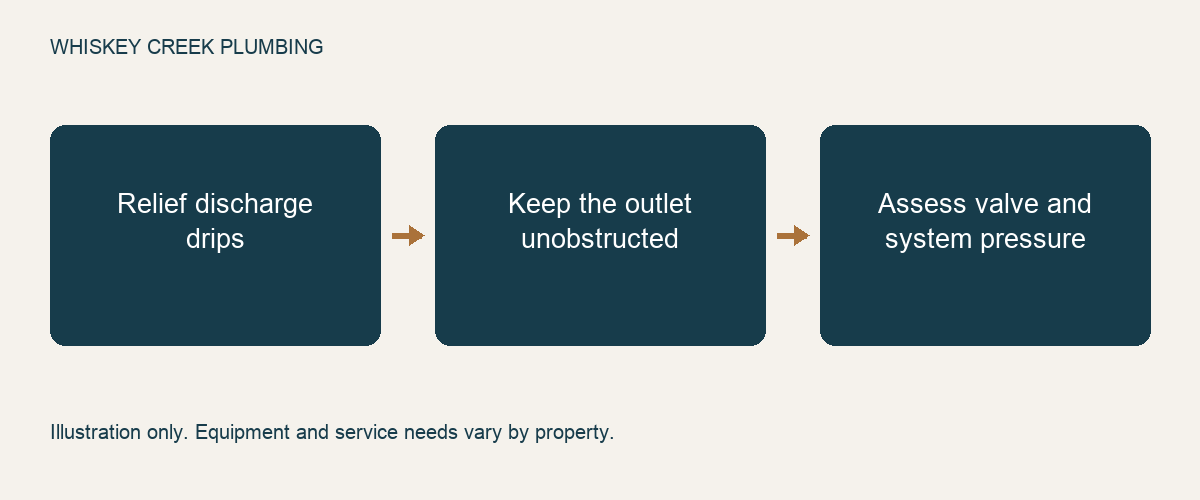
Water coming from a water heater’s temperature-and-pressure relief discharge needs professional assessment. The cause can involve system pressure, thermal expansion, the valve, or another operating problem. Never cap, plug, clamp, or otherwise obstruct the discharge to stop the water.
Identify the source without touching hot equipment
From a safe location, note whether water appears to come from the relief discharge, a nearby connection, a drain valve, or the tank area. Water can travel along surfaces, so a puddle’s location alone is not a diagnosis. Do not reach into a hot or wet equipment area to trace it.
Tell the plumber whether the dripping is continuous or appears after the heater reheats. Note any recent plumbing changes and visible equipment labels. Do not recreate the problem by raising the temperature, closing unfamiliar valves, or operating a relief valve without appropriate guidance.
Why pressure and expansion may matter
As water heats, its volume increases. In a closed water system, that change can increase pressure. A.O. Smith’s thermal-expansion bulletin identifies relief-valve dripping during a recovery cycle as one possible symptom. That timing is a clue for a technician, not confirmation that an expansion tank alone will solve the problem.
The assessment should consider the actual supply pressure, expansion-control arrangement, valve condition, and heater operation. A replacement valve may still discharge if the underlying system condition remains. Ask what was measured and what finding supports the proposed correction.
Protect the discharge path
The relief assembly is a safety device. A drain pan, hose, cap, or improvised fitting must not be used to defeat it. Keep children and pets away from discharge water and avoid standing water near electrical equipment. Do not remove a check valve or pressure-control device as a shortcut.
For an active leak or other unsafe condition, seek prompt professional guidance on whether the heater should be shut down and how to do that safely for its fuel type. Do not approach wet electrical controls. If you smell gas, leave and call the utility or emergency services from a safe location.
Questions before approving the repair
- Is the water definitely coming from the relief discharge?
- Were supply pressure and thermal expansion evaluated?
- Is the proposed work addressing the cause, the valve, or both?
- What operating checks will confirm the result?
- Does the quote cover any damaged pipe or related work, or only the stated component?
For a Fort Myers home, the installed plumbing arrangement determines the investigation. Do not assume every home has the same expansion-control equipment or that a dripping pipe requires a complete heater replacement.
Is occasional dripping harmless?
It should still be assessed. Record the timing and ask for a diagnosis instead of repeatedly draining, resetting, or obstructing the system. A clear explanation of the cause is more useful than simply hiding the water.
For related background, read Leaking Water Heater: Causes and Safe Next Steps. See our water-heater service and Fort Myers service information for the next step.
To discuss your property, call Whiskey Creek Plumbing at (239) 785-9022 or contact us.