
Trenchless sewer line replacement repairs or renews an underground sewer pipe through limited access points rather than digging a continuous trench along its full length. For homeowners comparing options, trenchless sewer line replacement may reduce surface disruption, but it is not the right fit for every damaged pipe or property. The condition and layout of the line determine what methods are possible.
Contact us to discuss your sewer line options
We help Fort Myers-area homeowners understand the problem before choosing a repair. This guide explains common trenchless approaches, what an evaluation can reveal, and how to compare a limited-access repair with open excavation. The goal is not to assume one method is best; it is to help you ask the right questions and understand what the proposed work includes.
What does trenchless sewer line replacement mean?
Trenchless sewer work uses access points, specialized equipment, or both to repair or replace an underground pipe without excavating its entire length. Depending on the line and the defect, a plumber may recommend a cured-in-place pipe (CIPP) liner, pipe bursting, or another repair approach. These methods are not interchangeable, and “trenchless” does not mean that no digging is involved.
A project may still require access pits, removal of a section of pipe, or work around cleanouts and connections. The aim is to limit how much of the yard, driveway, landscaping, or other surface must be opened compared with a continuous trench. The actual scope depends on the pipe’s location, condition, depth, and access.
Before recommending a method, a plumber typically needs to locate and inspect the line. A sewer line evaluation and installation service can help determine whether repair or replacement is needed and what options fit the specific line.
How do lining and pipe bursting differ?
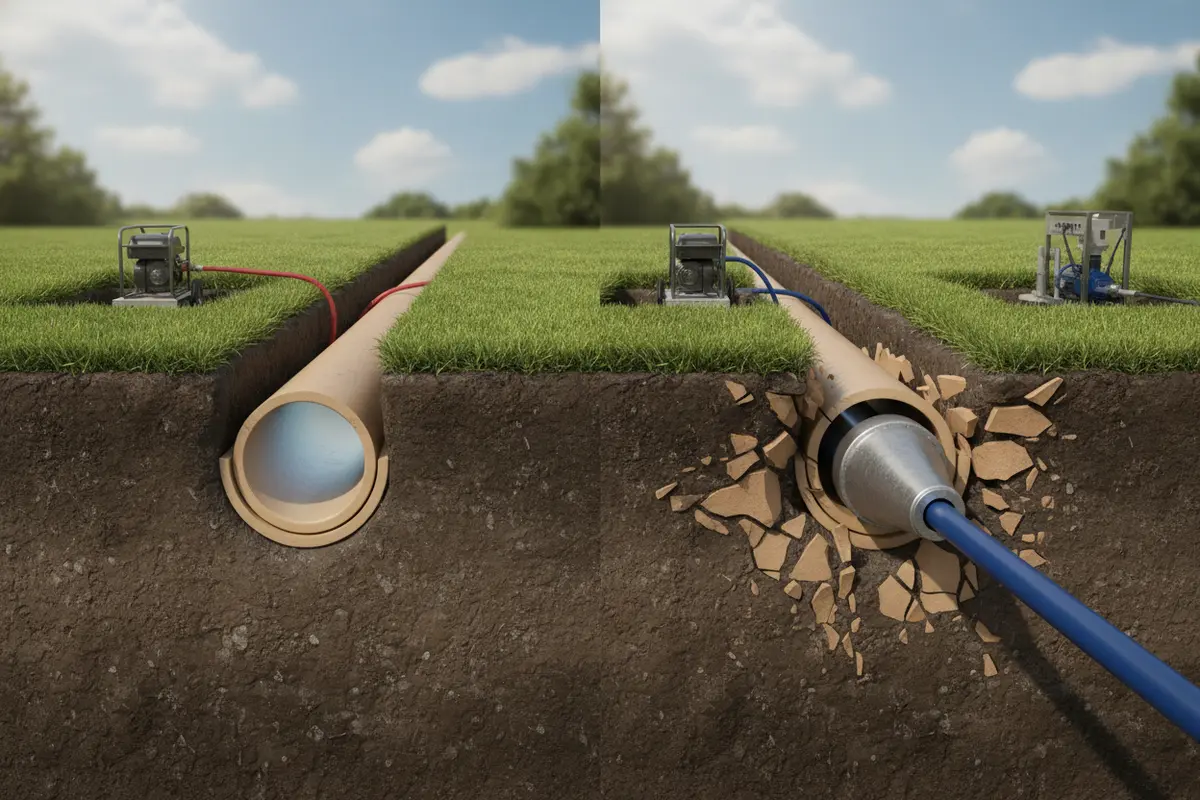
Two commonly discussed trenchless methods are lining and pipe bursting. In broad terms, lining renews the inside of a suitable existing pipe, while pipe bursting breaks apart the old pipe as a new pipe is pulled into its path. Both rely on access points, and neither is automatically appropriate for every sewer line.
Cured-in-place pipe lining
With CIPP lining, a resin-saturated liner is positioned inside the existing pipe and cured in place to form a new pipe wall. The liner relies on the existing line as a route and support during installation. The pipe must be suitable for the process, and the crew needs a workable path to prepare and install the liner.
Lining can be considered when a pipe has cracks, leaks, or other defects but its shape and route allow a liner to be installed. Conditions such as severe deformation, major collapse, or an unsuitable connection may rule it out or require additional work. Ask how the crew will handle branches, transitions, and connections to the main line.
Pipe bursting
Pipe bursting uses a pulling system and a bursting head to break the existing pipe outward while drawing a replacement pipe through the same general route. It can replace a pipe rather than simply forming a new interior lining, but it still needs access at the ends and enough room and suitable ground conditions for the equipment.
The route, nearby utilities, pipe material, depth, and available access all matter. Ask whether the planned work needs one or more pits, and what will happen at connections to the home and municipal system. A contractor should describe the specific setup for your property instead of treating every trenchless job as identical.
When might trenchless work be a good fit?
Trenchless repair may be worth evaluating when a sewer line is damaged underground and avoiding a long open trench could preserve valuable surfaces. It may be especially attractive when a line runs beneath landscaping, a driveway, a patio, or another area that would be difficult to restore. The presence of those surfaces alone does not prove trenchless work is feasible.
A professional evaluation should establish the location and condition of the defect, the line’s route, and whether the selected method can be installed safely. Some issues call for a localized repair; others require replacement or excavation. If a line has a belly, a major offset, a collapse, or a difficult change in direction, a liner may not correct the underlying geometry. The plumber should explain what the inspection shows and why the proposed method addresses it.
- Ask what the inspection found. Request a plain-language explanation of the defect, where it is, and how extensive it appears.
- Confirm the proposed method. Ask whether the recommendation is lining, pipe bursting, a spot repair, or open excavation, and why.
- Discuss access and surfaces. Identify the pits, cleanouts, and work areas, including what landscaping or hardscape may be affected.
- Clarify connections. Find out how the repair will connect to existing pipe and whether branch lines or transitions need attention.
- Get the scope in writing. Compare included preparation, repair, restoration, testing, and any exclusions.
Which symptoms call for a sewer line inspection?
Repeated problems can justify an inspection, especially when more than one fixture is affected or a drain problem keeps returning after basic clearing. Other warning signs may include sewage odors, unusual wet patches along a buried line, or a backup that seems to affect several drains. None of these signs proves that the sewer pipe needs replacement. A clogged branch, a fixture problem, or another plumbing issue can produce similar symptoms.
Pay attention to where and when the problem happens. Note which fixtures are slow, whether the issue is intermittent or persistent, and whether it changes after water use elsewhere in the home. Share those observations with the plumber. Do not repeatedly use chemical drain cleaners or attempt invasive work based only on a symptom. Those steps do not establish the condition of an underground sewer line and may create additional concerns.
An inspection helps separate a suspected sewer-line defect from other possible causes. Ask what the findings confirm and what remains uncertain. If the inspection identifies damage, the next question is not simply “Can this be done trenchlessly?” Ask whether a particular method can address that defect on your property, including its pipe route, access, and connections.
When may open excavation be the better option?
Trenchless work is a method, not a promise that excavation can always be avoided. A section of pipe may be too collapsed, misaligned, or otherwise unsuitable for lining or bursting. A site may lack appropriate access, or the route may have conditions that make a trenchless installation impractical. A targeted excavation can also be appropriate when the defect is localized and directly accessible.
Open excavation exposes the pipe, allowing a crew to see and replace or repair the affected section directly. The trade-off is that digging can disturb the ground and surfaces above the pipe, and the work may require restoration after the plumbing repair. What restoration is included varies by estimate, so homeowners should ask specifically about soil, sod, concrete, pavers, or landscaping rather than assume those costs are covered.
| Approach | How it works | What to confirm |
|---|---|---|
| Pipe lining | A liner is installed inside a suitable existing pipe and cured to form a new interior pipe wall. | Confirm the pipe shape, route, connections, and condition can support lining. Severe collapse or deformation may rule it out. |
| Pipe bursting | A bursting head breaks the old pipe outward while a replacement pipe is pulled through the general route. | Confirm access at the ends, ground conditions, nearby utilities, and how the new pipe will connect. |
| Open excavation | The affected section is exposed so it can be repaired or replaced directly. | Confirm the excavation area, utility locations, expected surface disruption, testing, and restoration scope. |
There is no universal rule that trenchless is cheaper or better. One published construction-cost comparison reported lower costs for CIPP renewal than open-cut replacement in the projects it studied. That research is useful context, not a quote or guarantee for a residential property: site conditions, scope, access, and restoration needs can change the comparison. Ask for a property-specific written price and a clear description of the work behind it. Read the construction cost comparison for CIPP renewal.
What happens during an evaluation and project?
The exact sequence varies, but a clear evaluation should connect the observed problem to a proposed solution. Here is a practical outline of what homeowners can expect to discuss.
- Describe the symptoms. Note recurring backups, slow drains, odors, or wet areas and when they occur. These signs can have more than one cause, so they do not identify a failed sewer line on their own.
- Locate and inspect the line. The plumber determines how to access the sewer and assess the line’s condition. Ask what portion was inspected and whether any section could not be viewed.
- Review the findings. Ask where the defect is, what it means for use of the line, and whether the issue appears localized or extensive.
- Compare workable methods. The estimate should explain why the recommended approach fits the line. If another method is unsuitable, ask what condition rules it out.
- Plan the work area. Confirm access points, expected water or sewer interruptions, protection of nearby property, and any preparation needed before work begins.
- Confirm completion checks. Ask what testing or inspection will be performed after the repair, and request the results and documentation for your records.
Problems that appear suddenly or involve an active backup need prompt attention. Our guide to what to do during an emergency plumbing repair covers immediate steps while you arrange help. Avoid using fixtures that worsen a backup, and do not enter areas where wastewater may pose a health risk.
How should homeowners prepare for the work?
Once you have a written plan, confirm the schedule, access route, and any instructions for using plumbing during the project. Ask whether the crew needs clear access to a cleanout, side yard, driveway, or interior area. Move vehicles and portable items away from the work zone, and tell the plumber about irrigation lines, outdoor lighting, or other features that may not be obvious. Do not dig or move buried utilities yourself.
Before work starts, confirm who will be your point of contact and how changes to the scope will be discussed and approved. Make sure you understand whether the work may temporarily interrupt sewer use, and what you should do if an unexpected backup or leak occurs. If a household member has accessibility or scheduling needs, raise them before the appointment so the work plan can account for them.
After the repair, ask what was completed and whether the planned post-work inspection or test was performed. Keep the estimate, any inspection findings, and completion documentation together with your home records. If you later notice recurring symptoms, report them promptly and refer to the location and scope recorded in those documents. This follow-through helps you and the plumber distinguish a new issue from a concern related to the repaired section.
What affects the cost and disruption?
A trenchless sewer estimate is specific to the property and the work. The method is only one part of the price. Scope, access, pipe depth and condition, length of the affected section, connections, equipment, and restoration can all affect the final plan. Local site conditions matter too, including whether other utilities or structures are near the route.
When comparing estimates, look beyond the total. Check whether each proposal includes the same length of pipe, method, access work, testing, cleanup, and surface restoration. A lower initial number may not represent the same scope. If the estimates recommend different solutions, ask each contractor to explain the inspection findings and what risk or limitation the selected method addresses.
- Which sections of pipe are included, and how was their condition assessed?
- Are excavation pits, access work, and connections included?
- What restoration is included or excluded for grass, landscaping, pavement, or concrete?
- Will the household have a period without normal sewer use? If so, when and for how long?
- What testing or inspection confirms the work is complete?
- What conditions could change the scope or price, and how will those changes be approved?
For a broader overview of pipe repair decisions, see our guide to pipe repair versus repiping. Sewer lines and indoor water piping are different systems, but the same useful habit applies: understand the diagnosed problem and compare the written scope, not just the label attached to the work.

How can you choose a plumber for this work?
Choose a plumber who can explain the condition of the line in plain language, describe why a method is appropriate, and define the limits of the work. You should be able to understand what access is required, what surfaces may be disturbed, what testing will follow, and what the estimate does not include. At Whiskey Creek Plumbing, we use fixed-price quotes so you can review the proposed scope and price before approving the work.
Ask for a written, itemized scope and compare like with like. A responsible recommendation should not rely only on a symptom such as a recurring clog. If symptoms continue, the source may be elsewhere in the plumbing system; our plumbing repair service can address other plumbing concerns as well. If you are ready to discuss a sewer-line evaluation, use our service scheduling page to get in touch.
Call to schedule a sewer line evaluation
Frequently asked questions about trenchless sewer line replacement
Does trenchless sewer replacement mean no digging?
No. Trenchless methods generally limit excavation along the entire pipe route, but access pits or other digging may still be needed. The plumber should identify where access is required and what surfaces could be affected.
Can every damaged sewer pipe be lined?
No. Lining depends on the pipe’s condition, shape, route, and access. A severe collapse, major deformation, or other site-specific condition may make lining unsuitable. An inspection helps establish whether a liner or another repair method is appropriate.
Is trenchless sewer work always less expensive?
No. Price depends on the scope, method, access, pipe condition, and restoration. Trenchless work may reduce some surface disruption, but that does not guarantee a lower total for every property. Compare written estimates that describe the same work.
How do I know whether I need repair or replacement?
Symptoms alone cannot determine the answer. Ask a plumber to inspect the line, explain the location and extent of the defect, and show how the proposed work addresses it. A localized issue may call for a different solution from widespread damage.
Discuss the right sewer line next step
Call Whiskey Creek Plumbing at (239) 785-9022.
We will help you understand the available options and the work your property may need, with a clear explanation before you decide how to proceed.