
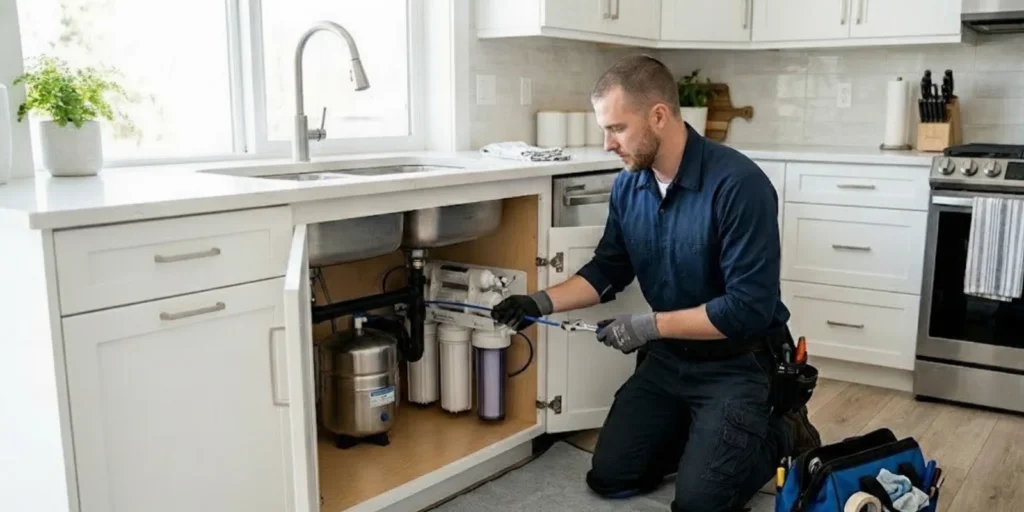
A plumber for water filter installation is most useful when the system connects directly to household plumbing, needs a new branch or shutoff, or must be fitted to a whole-home water line. A small faucet-mounted or countertop unit may be simple to install yourself, but leaks, tight access, unfamiliar pipework, or uncertainty about the right connection are good reasons to ask a professional. The right choice depends on the equipment and what the installation changes.
Talk with our team about your water filter installation
When should you hire a plumber to install a water filter?
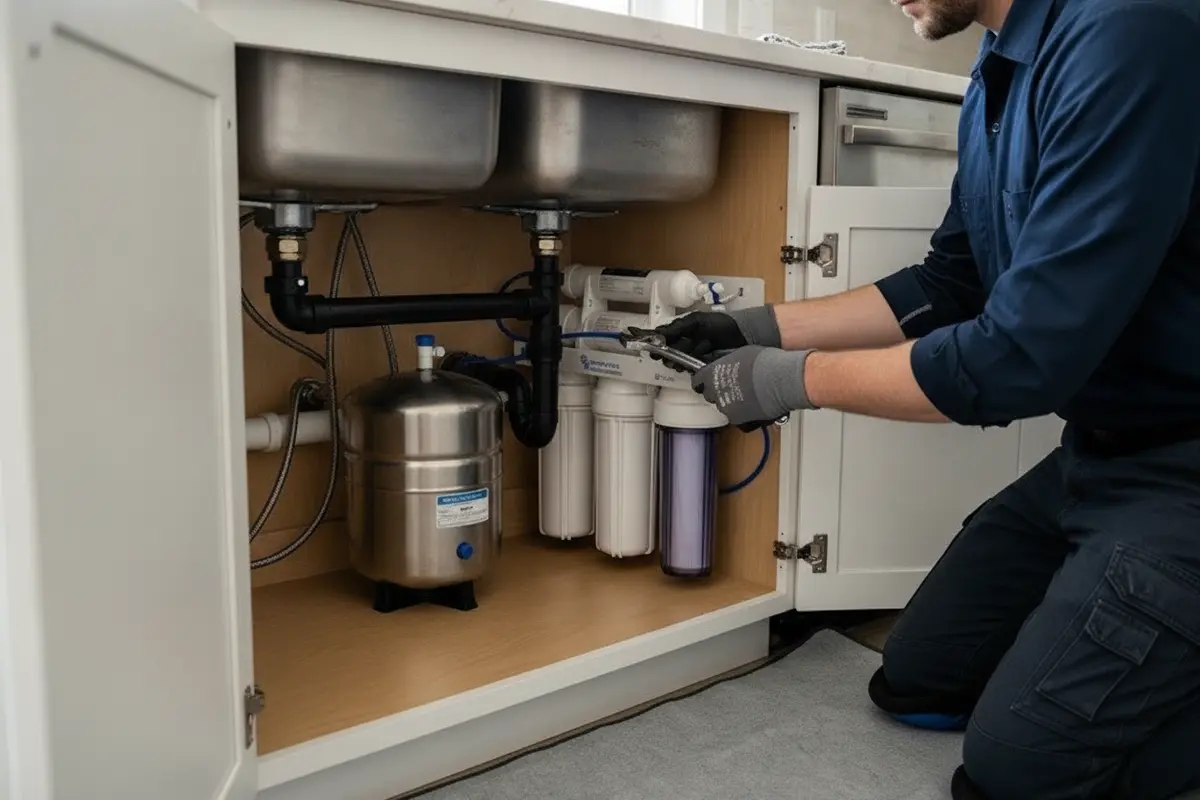
Hire a plumber when installation involves altering, extending, or reconnecting a water line, or when you cannot confidently isolate and restore the water supply. A plumber can assess the intended connection point, confirm that the fittings suit the existing pipe, and check for leaks after the system is connected. This is particularly useful for under-sink systems, reverse-osmosis units, and whole-house filters, which often need more than a filter cartridge swap.
A filter is not automatically a plumbing project. Many pitcher, faucet-mounted, and countertop models attach without changing fixed plumbing. Follow the product instructions, check that the connections fit your faucet, and stop if the unit leaks or the setup requires a modification you do not understand. Do not force mismatched fittings or keep tightening a connection that is still leaking.
- Call a plumber: the filter connects to a fixed water line, a new shutoff or branch is needed, or the installation instructions call for cutting or adapting pipe.
- Ask for help: the shutoff valve is stuck, corroded, hard to reach, or will not fully stop the water.
- Pause and get advice: you see existing moisture, corrosion, damaged tubing, or a previous repair around the connection.
- DIY may be reasonable: the device is designed to attach to a faucet or sit on a counter, and the instructions require no plumbing alteration.
These are practical decision points, not a substitute for the product maker’s directions. A plumber can also help determine whether the proposed location is accessible for future cartridge changes or system servicing.
Which water filter installations are more complex?
Filter styles differ in how they connect. A cartridge that twists into an existing housing is a maintenance task. A new system that ties into a supply line is a different job. Before buying equipment, identify whether it is a point-of-use filter serving one faucet or a whole-house unit connected where water enters the home. The product specifications should identify the connection needs; if they are unclear, ask the seller or a plumber before opening the package.
| Filter or task | Typical plumbing work | When to call a plumber |
|---|---|---|
| Pitcher or dispenser | Fill and use; no fixed connection | Usually not needed for installation |
| Faucet-mounted or countertop | Attaches to a compatible faucet | If the faucet is damaged, fittings do not match, or a leak persists |
| Under-sink filter | May connect to a cold-water line and dedicated faucet | When adding a branch, faucet, shutoff, or adapting fixed pipe |
| Reverse-osmosis system | Often includes multiple stages and may require a dedicated faucet and drain connection | When connections or routing are uncertain, access is tight, or plumbing must change |
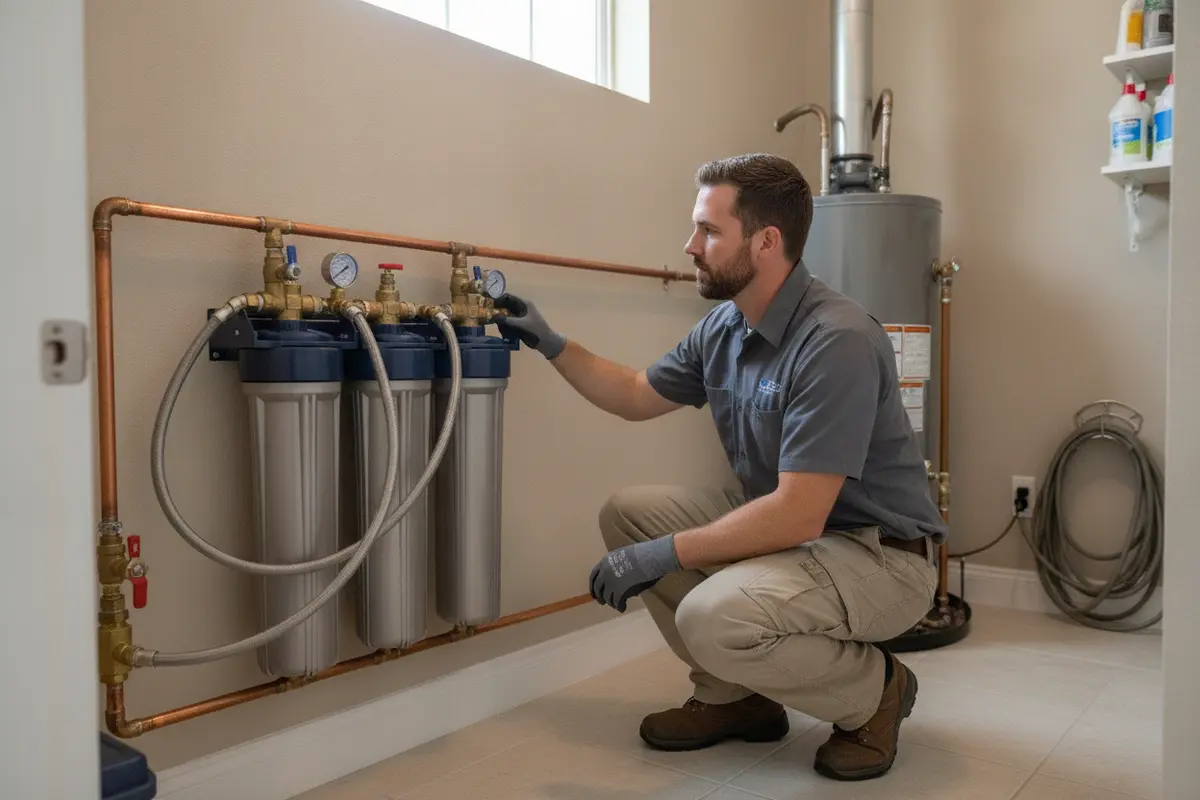
| Whole-house filter | Connects to the main supply line and may require rerouting or service valves | For line cutting, new valves, difficult access, or any uncertainty about the main line |
| Replacing an existing cartridge | Opens and reseals an existing filter housing | If the housing is stuck, cracked, cross-threaded, or leaks after replacement |
This is a general comparison, not a promise that every model installs the same way. Read the instructions for the exact unit. Some systems need additional space, a drain connection, or a nearby power source; others have different requirements. If the installation involves a water line, our plumbing services in Lee County page explains how to reach our team about plumbing work.
What warning signs mean you should stop a DIY installation?
Stop work and close the nearest usable shutoff if water begins leaking or you cannot control the supply. Do not continue tightening fittings, cutting pipe, or testing connections if you are unsure what they serve. Water can escape quickly, and an improvised repair can make the next step harder.
- The shutoff will not close: Do not force a stiff valve. If the water continues flowing, you may need to shut off the home’s main supply if you can do so safely.
- A connection drips after hand-tightening: Turn off the water and check the instructions for the correct fitting and seal. Do not add tape or sealant unless the instructions call for it.
- The pipe or valve moves with the fitting: Stop. Twisting fixed plumbing can stress a joint that is not meant to turn.
- You find corrosion, a crack, or old patchwork: The issue may go beyond the filter installation. Have the existing plumbing assessed before adding a new connection.
- You cannot identify the line: Avoid cutting or disconnecting it until you know what it supplies and how to isolate it.
If water is actively escaping, protect nearby belongings and use an accessible shutoff only if you can operate it safely. For a leak that continues or an unknown shutoff, contact a plumber rather than leaving the connection under pressure. If you suspect a hidden plumbing leak, see our information about water leak detection and the signs that warrant further inspection.
What should you check before choosing a filter?
Start with the reason you want a filter. Is the goal taste, sediment, a particular concern identified in a water test, or treatment at more than one tap? Different products are designed for different uses, so do not assume one filter addresses every concern. Check the manufacturer’s stated capabilities, replacement schedule, dimensions, and connection requirements. If the concern is about water quality, identify what needs to be addressed before choosing equipment; a plumber can assist with plumbing connections, but the filter choice should match the specific need.
There are many filter types available for households. A UCLA Luskin Center report notes the range of household water-filter options and the availability of do-it-yourself guidance; that variety is a good reason to compare the needs and connection requirements of the particular product rather than choosing by appearance alone. Read the UCLA report on household water filters.
Before you buy, make a short checklist:
- Write down which tap or water supply you want the system to serve.
- Read the specifications for what the filter is designed to reduce or treat; do not rely only on broad words such as “clean” or “pure.”
- Confirm the pipe or faucet connection type, required space, and whether the system needs a drain or electrical outlet.
- Check how often cartridges or other components need replacement and whether those parts are available.
- Photograph the intended installation area and note any existing leak, corrosion, or access problem before requesting a quote.
If you are deciding between an under-sink filter and a system on the main water line, consider the coverage you need and the work required to connect each type. A whole-house installation affects the incoming supply, while a point-of-use model is intended for a particular outlet. The product’s directions and specifications are the starting point for a sound decision.
How can you avoid a filter and plumbing mismatch?
Check the actual connection point, not just the general location where you hope to install the system. Under a sink, look for the available cold-water shutoff, the faucet style, the room around the cabinet, and whether an existing filter or dispenser is already connected. For a main-line system, locate the area where the supply enters and note how much clear working space is available. Do not remove panels or alter pipework simply to get a better look.
Compare those observations with the equipment manual. Confirm the listed inlet and outlet sizes, the direction of flow, any space needed to remove the housing, and whether the unit calls for a drain or electrical connection. A filter can physically fit in a cabinet yet be difficult to service if there is no room to turn the housing or replace a cartridge. An installation location should allow routine access as well as the initial connection.
Be careful with product descriptions that make broad claims without clearly identifying the unit’s intended use. Match the documented capabilities to the concern you are trying to address, and check whether the filter is designed for one fixture or a wider section of the home’s plumbing. If a manufacturer specifies limits or operating conditions, treat them as part of the decision. A plumber can help review the plumbing layout and connection work, but selecting treatment equipment still starts with the product’s documented purpose.
If you already own a filter, keep the manual and all supplied fittings available for the visit. Do not discard packaging until you have confirmed that the product and parts are suitable for the planned connection. If the instructions call for a component that is missing, resolve that before the installation appointment. This prevents a simple compatibility problem from becoming an unexpected change in scope on the day of service.
What happens when a plumber installs a water filter?
The exact steps depend on the unit and existing plumbing, but a professional installation generally begins with checking the location and the equipment instructions. The plumber identifies the intended supply connection, confirms the water can be shut off, and reviews whether the available space and pipe arrangement suit the system. If the setup calls for a new branch, valve, or connection, the scope should be clear before work begins.
After connecting the unit, the plumber restores the supply and checks the fittings for leaks. The system may need flushing or startup steps specified by its manufacturer. Ask what was installed, where the shutoff is, which cartridge or part is needed later, and what instructions apply before using the filter. Keep the product manual and any maintenance information with your home records.
For a whole-house unit, access to the main line matters. A clear workspace can help the plumber inspect the route and plan service access. If the intended location is crowded, blocked, or close to stored items, clear what you safely can before the appointment. Do not move or disconnect existing plumbing to prepare the area.
What should you confirm before the work is finished?
Before the plumber leaves, ask to review the completed connections and the location of each shutoff related to the filter. Confirm that the area is dry after the system has been pressurized and that the filter housing, tubing, and nearby fittings are not dripping. Check the manufacturer’s startup instructions together, including whether the unit needs an initial flush before its water is used. The exact flushing procedure depends on the model, so follow its instructions rather than assuming all systems start the same way.
Make sure you know which parts will need routine replacement and how to access them without pulling on the connected tubing. Ask whether the filter needs a specific replacement cartridge and where the model information is recorded. If the unit has a bypass or shutoff, learn how it is operated and what it does. Keep the manual, any installation notes, and the quote together so you can refer to the agreed work and the maker’s maintenance guidance later.
Take a quick look around the work area after the first use and again later that day. A dry connection at the moment of installation is useful, but a small seep can be easier to spot after normal use. If moisture appears, shut off the filter supply if it is safe to do so and call for help rather than disassembling a new connection. For a system installed out of sight, put a reminder on your calendar to check the area when you replace the cartridge.
These checks do not replace any inspection or maintenance schedule stated by the filter manufacturer. They help you understand what was installed and make it easier to notice a change. A well-planned installation should leave the homeowner knowing how to access the equipment, where water can be isolated, and what routine care the product requires.
How can you prepare for an installation quote?
A useful quote starts with clear information about the work. Share the filter make and model, whether you already own the unit, where you want it installed, and whether the job is a replacement or a new connection. Photos of the cabinet, main line, shutoff, and nearby drain or outlet can help explain the layout. Mention any active or previous leaks rather than treating them as part of the filter job without discussion.
Ask the plumber to explain the proposed connection, what is included in the work, and whether the quote assumes any additional changes. Whiskey Creek Plumbing uses fixed-price service, so you can ask about the price for the specific agreed scope before work begins. A clear scope is important: a quote for connecting a compatible unit is not necessarily the same as one that includes new valves, pipe rerouting, or repairs to existing plumbing.
Useful questions include:
- Does this unit connect to the existing plumbing as it is, or will a new branch, valve, or faucet be needed?
- Does the installation include the product, or should I supply it?
- What testing or manufacturer startup steps are included?
- What happens if you find a damaged shutoff or existing leak?
- How should I access and replace the filter later?
- What work is included in the fixed price, and what would require a separate approval?
For a system that connects at the main supply or needs water-line changes, you can also review our water line plumbing information. If you are unsure whether your home is within our coverage area, check our Southwest Florida service areas.
Call (239) 785-9022 to discuss your filter installation
Frequently asked questions
Can I install a water filter myself?
Some pitcher, faucet-mounted, and countertop filters are designed for homeowner installation without changes to fixed plumbing. Follow the specific instructions and stop if the fittings do not match, the faucet is damaged, or a leak persists. Under-sink and whole-house systems may require plumbing changes, so review the instructions and get help if the connection is unclear.
Does an under-sink filter always need a plumber?
No. The answer depends on the filter, the existing shutoff and supply line, and the work described in the instructions. If the unit connects to an existing compatible valve and you can safely isolate the water, it may be straightforward. A plumber is a sensible choice if you need to add a dedicated faucet or branch, adapt pipe, or deal with a stuck valve or leak.
Should a plumber install a whole-house water filter?
A whole-house filter connects to the main water line, so installation can involve shutting off and modifying the home’s supply piping. A plumber can assess the location, connection, and service access before the line is changed. Confirm the filter’s requirements and the exact work included in the quote.
What should I do if the filter leaks after installation?
Turn off the filter’s supply valve if you can reach and operate it safely. If the leak continues, use the home’s main shutoff only if you know how to do so, and contact a plumber. Do not keep tightening a leaking fitting or leave it pressurized while you wait.
How do I know which water filter I need?
First identify what you want the filter to address and whether you need treatment at one tap or throughout the home. Compare the product’s stated capabilities, connection requirements, and maintenance instructions. If your decision depends on a specific water-quality concern, seek information relevant to that concern before selecting a system.
Plan your water filter installation
Choose the filter based on the need it is designed to address, then check its connection requirements before installation day. If the work involves fixed plumbing, a new valve, or a main-line connection—or if you find a leak or cannot safely shut off the water—get a plumber’s advice before proceeding.
Call (239) 785-9022 to plan your water filter installation
We can help you understand the plumbing scope and the next step for your home or business in Southwest Florida.